





Software Development
Custom APIs and Connection Bridges


Custom connections that automate data exchange and help your digital ecosystem evolve.
Your business software operates in silos, your teams enter the same data in multiple places, and your decisions rely on information that is not available in real time. Custom API integration and development connect your systems, automate data flows, and turn your data into a business asset. Exolnet designs solutions tailored to your ecosystem and specific business rules.
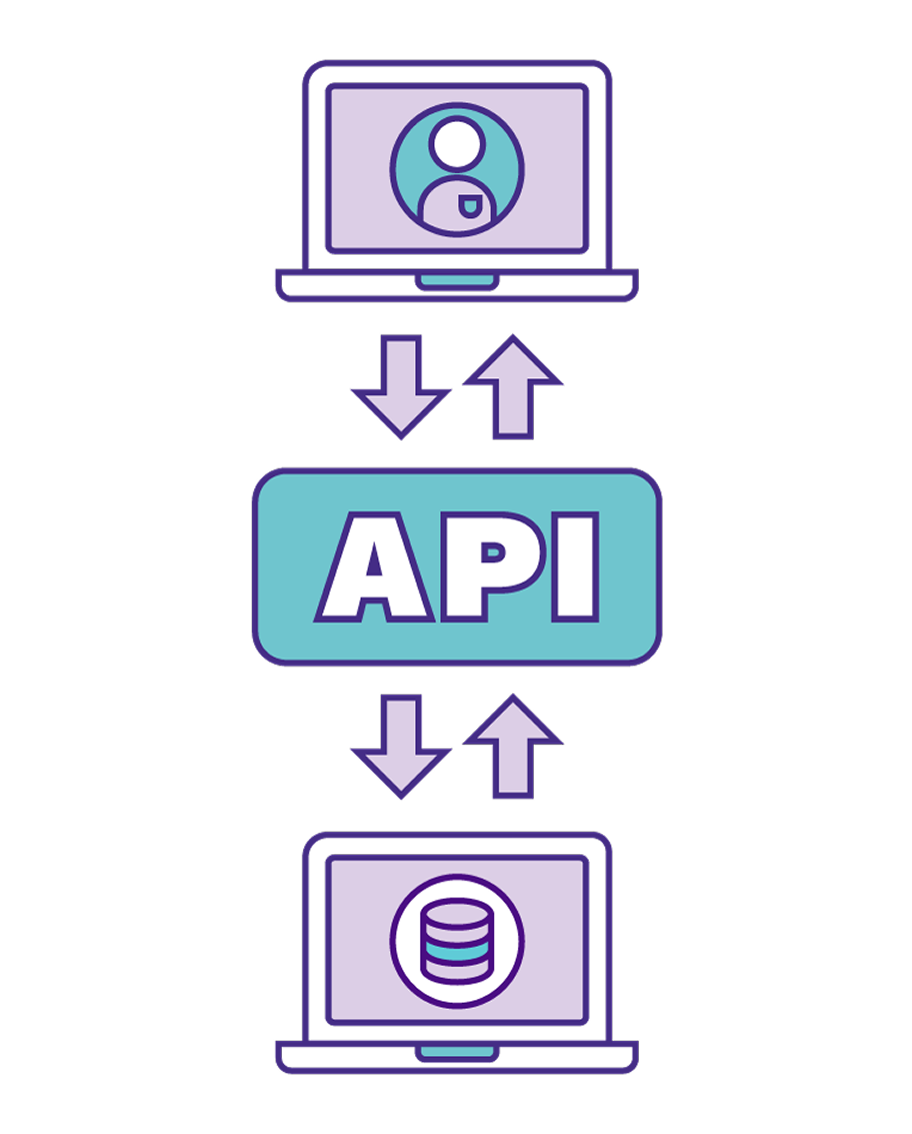
An API (application programming interface) is a bridge that allows two applications to communicate. It works like a server in a restaurant: the server takes the customer’s order, delivers it to the kitchen in a format it can understand, then brings back the result.
API development involves designing this interface so it exposes the right data to applications, in the right format, with the right security rules. When your website displays a Google Map, it uses an API. When your online store sends an invoice to your accounting software, it uses an API. Every time one system needs to read or update another system’s data, an API is working behind the scenes.
An API can be public, which means it is accessible over the Internet and often secured with an access key; internal, which means it is used by your teams or systems; or partner-facing, which means it is available to organizations that work with you.
Integration is the work of connecting your system to an existing API. API development creates a new communication channel that allows your systems or partners to access your data.
Several situations indicate that an API or integration is needed:
Your software systems do not communicate with each other. Your CRM, ERP, online store, and custom tools operate in silos.
Your teams manually enter the same data into several systems, creating errors.
Your Quebec-based or custom software does not integrate naturally with international tools such as Salesforce.
You regularly need to consult external sources, including government systems such as RAMQ, Revenu Québec, or the Bank of Canada.
Your data is not available in real time.
You want to open your platform to partners or monetize access to your data.
You are developing a mobile application that needs to access data or features shared across users.
Our article on custom APIs and connection bridges explores these challenges in greater detail.
Do several of these situations sound familiar?
Let's assess your needs
REST APIs
The most widely used standard for web communication between applications.
GraphQL APIs
Particularly well suited to applications whose data needs vary by screen, feature, or user type.
MCP APIs (Model Context Protocol)
Make your systems accessible to AI assistants.
Connection bridges
Connect software systems that were not designed to communicate.
Data hubs
Centralize information from multiple sources before redistributing it.
APIs for web and mobile applications
Designed for performance and scalability.
APIs for partners or external ecosystems
Include authentication management and usage-based billing.
REST, GraphQL, and MCP address different integration needs. REST remains the standard for structured exchanges between applications. GraphQL offers greater flexibility when data requirements vary across interfaces, while MCP gives AI assistants and agents standardized access to data, tools, and actions. This table highlights their main differences to help you choose the approach best suited to your context.
Criterion | REST API | GraphQL API | MCP |
|---|---|---|---|
Maturity | Industry standard since 2000, widely adopted | Newer (2015), with growing adoption | Emerging (2024), specific to AI |
Response format | Defined by the server | The client specifies the required fields | Structured for conversational interactions |
Caching | Simple and native to the web | More complex to cache | N/A (dynamic interactions) |
Best suited when | Data exchanges are predictable, resources are clearly defined, and compatibility with many systems is a priority. | Interfaces have variable data requirements and must retrieve exactly the information they need. | An AI assistant or agent needs to consult data, use tools, or trigger actions in a controlled environment. |
Example | An online store automatically sends orders and customer data to an accounting system. | A multiscreen mobile application adapts the data it retrieves for each view and user type. | An AI agent consults inventory and customer records, then prepares a quote using the available information. |
In API development, the choice of technology always depends on business needs, data volume, and technical constraints. Our services are often part of broader custom web application, custom software, or software modernization projects.
Unlocking the value of your data: If you have accumulated relevant data, an API can make it available to partners or customers.
Fewer human errors caused by manual data entry
Process automation: An order can automatically trigger invoicing, inventory updates, and CRM synchronization.
Real-time data: Keep your dashboards and decisions current.
Scalability: A well-designed API makes it possible to add systems without redesigning everything.
Access to your ecosystem: Partners can integrate your services into their products.
Easier AI integration: MCP APIs allow AI assistants to consult your data and take actions.
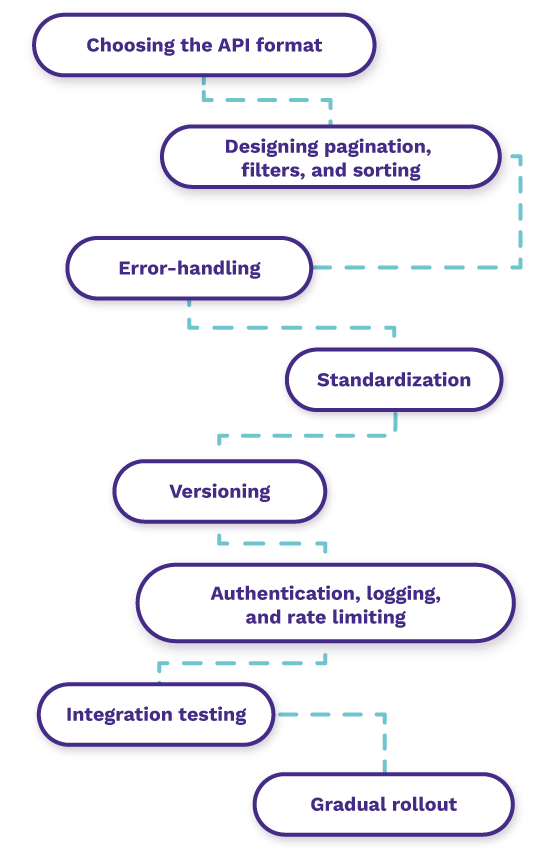
An API goes far beyond data exchange. It is a product in its own right that will be consumed by other developers or systems. We systematically design the following aspects:
Choosing the API format
REST, GraphQL, or MCP, depending on business needs and the nature of the data.
Designing pagination, filters, and sorting
How API consumers will request subsets of data without overloading the system.
Error-handling strategy
Consistent response codes, actionable messages, and predictable behaviour.
Standardizing data formats
Dates, currencies, time zones, and numbers are standardized from the start.
Versioning and documentation
Allowing the API to evolve without breaking existing integrations. A poorly documented API is ignored.
Authentication, logging, and rate limiting
API keys, OAuth, JWT, traceability, and protection against abuse.
Integration testing and gradual rollout
Support for the teams integrating the API.
All production work is completed by our Montréal team, with no outsourcing.
Our API integration and development projects make it easier for systems to exchange information while ensuring data reliability, security, and seamless flow.
Aggregation of more than 150 data sources
For the Association québécoise des pharmaciens propriétaires (AQPP), we designed Substance, a cloud platform that aggregates data from more than 150 pharmaceutical companies and the RAMQ. Substance’s analytics engine automatically interprets the specific characteristics of each source to consolidate more than 15,000 medications into a single database. An API was then developed to share this aggregated data between Substance and the pharmacists’ member portal, ensuring that consolidated information remains available and accessible to end users.
Learn more
Centralization of 3 real estate data sources
For DuProprio, we developed Jarvis, which centralizes real estate data from three distinct sources: DuProprio’s internal database, an external land registry solution containing records for hundreds of thousands of properties, and manual entries from appraisers. The APIs and integrations built for Jarvis ensure data standardization and real-time updates.
Learn more
Exolnet built a high-performing and elegant solution for our complex needs. The solution quickly became essential to the organization thanks to its power and ease of use. Changes across Desjardins Group are now under control!
If your software systems do not communicate, your teams lose time to duplicate data entry, or you want to make your data available to partners or AI assistants, let's talk. Our team can analyze your infrastructure and recommend an API integration and development strategy tailored to your operational reality.
Custom API development becomes relevant when your business rules, data formats, or security requirements exceed what prebuilt connectors can support. Although quick to implement, these connectors often impose constraints such as predefined fields, fixed synchronization frequencies, or limited customization. A custom API can accurately reflect your business logic and define precisely which data is accessible, by whom, and in what format.
REST is the most widely used standard, with each resource available through its own endpoint. GraphQL lets applications request exactly the fields they need, reducing unnecessary data transfers. MCP (Model Context Protocol) makes your systems accessible to AI assistants such as ChatGPT or Claude. The right choice depends on your needs and the nature of the data exchanged.
A one-time integration between two systems can start at around CAD $15,000 to $40,000. A complete API with authentication, documentation, version management, and multiple integrations can range from CAD $100,000 to $300,000 or more. The cost depends on the number of systems, data volume, and business rules involved. We provide a detailed estimate after an initial meeting.
Yes, when designed properly. API communications are protected by multiple layers, including authentication (API keys, OAuth, JWT), encryption in transit (HTTPS, TLS), granular access controls, rate limiting, and call logging. API security must be designed from the start, not added later as a patch. We apply this practice systematically to every project.
We’d be more than happy to chat about your technology goals and always enjoy learning about new businesses along the way. Get in touch today!