




Software Development
How to Choose a Custom Software Developer: The 10 Key Questions


Validate your idea, launch a solid MVP, and build a digital product ready to scale.
You have identified a problem that existing software does not solve well, or a market that still relies on Excel and manual processes. You want to turn it into a profitable product, but building a SaaS platform used by hundreds or thousands of customers requires much more than programming.
Exolnet helps entrepreneurs, intrapreneurs, and startups quickly launch an MVP (minimum viable product), reduce risk, and establish a solid foundation for a custom web application designed to support their growth.
A SaaS (Software as a Service) platform is software accessed through the web, with no installation required, and is generally offered through a monthly or annual subscription. Users pay to access the product, which is continuously updated.
The SaaS model benefits both users and businesses. Users have nothing to install and can access the software from anywhere. For the business, subscriptions generate recurring revenue that is easier to forecast.
Depending on your goal, there are two possible strategies: build an MVP to test the market and validate your idea with a limited investment, or develop a mature SaaS product ready for large-scale commercialization, with paid subscriptions and advanced features that continue to evolve.
Several signs indicate that an idea is ready to become a SaaS platform:
You have identified a common problem that existing software does not address well.
An entire market still relies on Excel or manual processes, suggesting an opportunity for automation.
The industry is fragmented, and users switch between 5 and 10 tools to complete a single workflow.
The Quebec or Canadian market is poorly served by U.S. solutions because of language, tax, or regulatory requirements.
You want to move from a service-based model to a subscription-based model.
You have valuable industry expertise that you want to turn into a product.
Do several of these points sound familiar?
An MVP (minimum viable product) is the simplest version of your product that already delivers value to an initial group of users. It is also the best way to reduce the risks of a SaaS project.
Criterion | MVP | Full commercial version |
|---|---|---|
Primary objective | Validate the market quickly | Accelerate growth |
Features | Features essential to the application's operation | Essential features and a complete ecosystem, including advanced features |
Initial users | Limited group | Large-scale rollout |
Typical investment | Controlled and incremental | Higher initial investment, followed by incremental investment |
Time to launch | Rapid launch | Rollout in several phases |
Success criteria | Hypothesis validation, conversion rate, and retention rate | Growth, retention, and monthly recurring revenue |
Product evolution | Rapid iterations based on feedback from initial users | Continuous evolution based on a product roadmap |
Our team has published a detailed article on the MVP approach that explains our philosophy and the pitfalls to avoid.
From validating an idea to bringing a product to market at scale, we design SaaS platforms tailored to your vision and stage of growth. Each solution combines scalable architecture, an intuitive user experience, and the features needed to create real value in your market.
Our approach combines several of our services: custom software, artificial intelligence, product design, and API integration and development.
Funding for a SaaS product can come from several sources: personal investment, grants, tax credits, loans, angel investors, or venture capital funds. Across Quebec, economic development organizations, incubators, accelerators, and tech communities can help you structure your project, identify the right programs, and meet financial partners.
The ideal strategy evolves with the product. Public funding and support can help develop the MVP, while private capital often becomes relevant once the market is validated and the company wants to accelerate growth.
Resource | Type of support | Particularly useful for |
|---|---|---|
Free guidance, referrals to programs, and access to certain local funds | Structuring the project and discovering resources available in your region | |
Loans, investments, guarantees, and government programs | Financing a launch, commercialization, or growth | |
Specialist advice and funding for certain innovative technology projects | Supporting research, development, and commercialization | |
Mentorship, training, guidance, networking, and funding preparation | Validating the business model and preparing for market launch | |
Community, content, and events for Quebec SaaS companies | Connecting with other founders and growing your network | |
Investor meetings, mentorship, and opportunities to pitch your project | Increasing visibility and building relationships within the ecosystem | |
Private capital, expertise, and guidance from angel investors | Accelerating a product that has already shown commercial potential | |
Search tool that brings together various government programs | Finding assistance that matches the sector, region, and project stage |
Working with an experienced team like Exolnet delivers value that goes far beyond writing code:
Product clarification: An experienced firm takes a critical look at your assumptions and helps you avoid common pitfalls when designing a digital product.
Faster time to market: With a seasoned team and proven tools, you can move from concept to launch more efficiently.
Fewer costly mistakes: Poor requirements, code generation without architectural planning, design issues, poorly considered database structures, and UX that is not optimized for conversion are early decisions that can be very expensive to correct later.
Experienced collaborators by your side: Our team works closely with yours to refine requirements, identify blind spots, and build the product that best reflects your vision.
A solid technical foundation for product growth: Our code is readable and documented, uses leading, proven technologies, and is designed so that your internal team can eventually take over.
Security and compliance expertise: Essential when your SaaS will manage data for hundreds of customers.
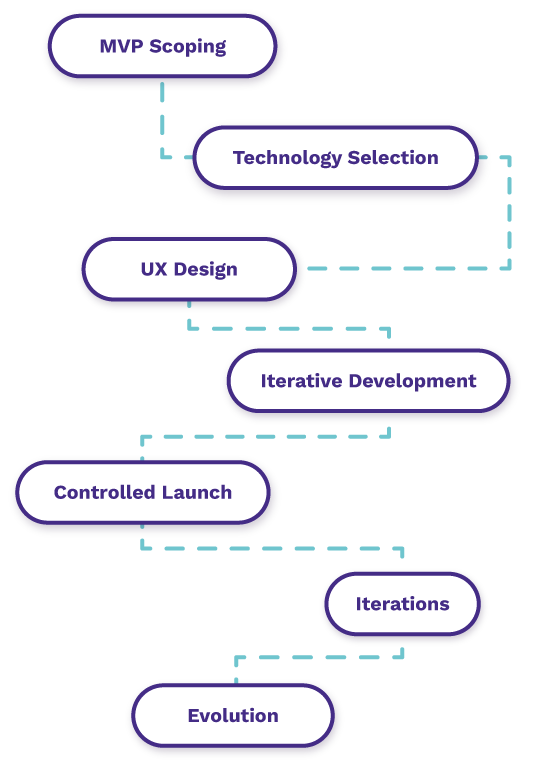
Our process is designed to validate quickly and invest wisely.
Scoping the MVP and the assumptions to validate
We distinguish what is essential from what is simply desirable because most SaaS products that fail tried to do too much at launch.
Choosing technologies and architecture
We select popular, proven technologies suited to your product, along with scalable cloud hosting and an architecture designed for future needs such as new features, integrations, and increased traffic.
UX design and interactive prototypes
Validated with target users before development begins.
Iterative MVP development
Includes demonstrations every two weeks.
Controlled launch with initial users
Collection of qualitative and quantitative feedback.
Data-driven iteration
Based on observed user behaviour, we prioritize additions with the greatest impact on user retention and business growth.
Evolution toward the full commercial version
Once the MVP is validated, we add features that take your product further and help it stand out from competitors.
Exolnet delivers high-quality custom solutions, backed by a multidisciplinary team with deep expertise in the field. It was a real pleasure working with them.
If you have identified a problem not well served by existing software and want to turn it into a profitable SaaS platform, let's talk. Our team can evaluate your concept, help you prioritize MVP features, and structure a development plan tailored to your vision and budget.
A SaaS platform (Software as a Service) is software accessed through the web, with no installation required, and is generally offered through a monthly or annual subscription. Users pay to access the product, which is continuously updated without interruption. It is the dominant model for new software products because it provides predictable recurring revenue and maximum accessibility.
Most SaaS products fail not because they are poorly coded, but because they address demand that does not truly exist. An MVP (minimum viable product) lets you validate real traction with initial users using a limited investment, instead of committing hundreds of thousands of dollars to untested assumptions. It is also the best way to reach the market quickly.
In Quebec, the cost of an MVP generally ranges from $50,000 to $200,000, depending on complexity. A simple MVP typically costs between $50,000 and $100,000, while a more advanced MVP can reach $200,000 or more. Evolving the product into a full commercial version can then add several hundred thousand dollars over 12 to 24 months.
Depending on the scope of the MVP, development generally takes four to six months from initial scoping to launch with the first users. Once the MVP has been validated in production, evolving it into a full commercial version can take another six to 12 months. We work in iterative cycles with demos every two weeks so we can continuously adjust based on your feedback.
We’d be more than happy to chat about your technology goals and always enjoy learning about new businesses along the way. Get in touch today!